 GITEX Dubai
 Ai Everything
 LEAP26
 AI
 Saudi Arabia
 UAE
 Egypt
Making Content More Accessible, Interactive and Useful: How Zentrovia Is Rethinking Digital Publishing.

13 min
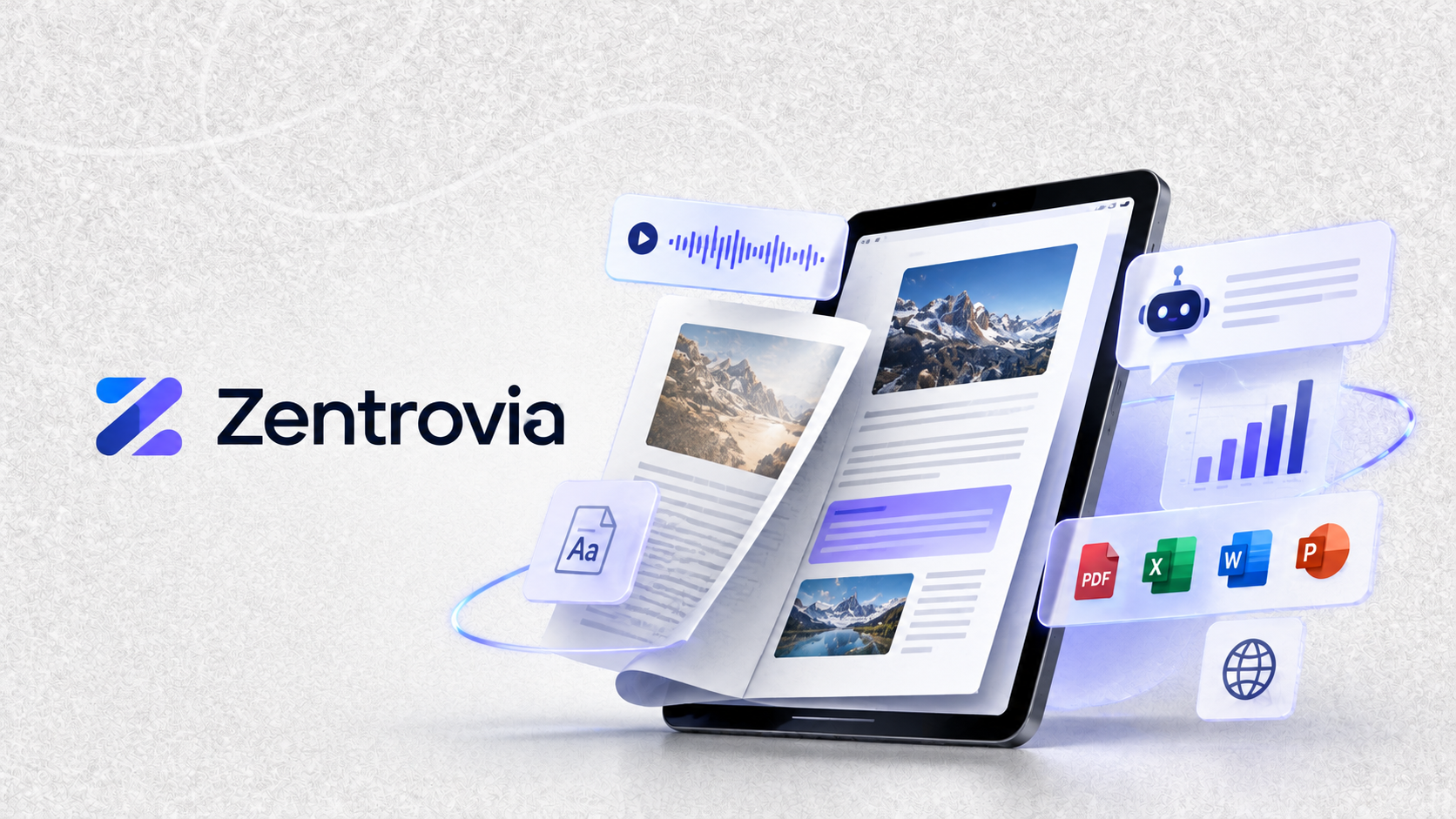
Zentrovia helps organisations use existing content better, not “rebuild everything from scratch”.
Its tools let readers ask questions of PDFs, ebooks and guidelines, with source citations.
ZenFlip turns a “humble PDF” into an interactive flipbook with chat and analytics.
The company also handles conversion, accessibility and publishing systems behind digital content.
Its broader aim is simple: make information more accessible, interactive and useful.
From AI-powered document search to interactive publications, Zentrovia is exploring how publishers, educators and organisations can make their existing content more useful in an increasingly AI-driven world.
There's something rather strange about the way we consume information today.
We have AI assistants capable of writing software, analysing complicated problems and explaining almost anything in seconds.
Yet open a 200-page PDF document, and there's a good chance you'll still find yourself scrolling endlessly, searching for a particular paragraph or trying to remember which page contained the information you needed.
Not exactly the future we imagined.
And to be fair, there's nothing inherently wrong with PDFs. They've been around for decades, they work practically everywhere, and they're still one of the most reliable ways to share documents without worrying about how they'll appear on different devices.
But the way we interact with information is changing.
People increasingly expect to search, ask questions and interact with content rather than simply read through it from beginning to end.
For publishers, educational institutions and organisations managing large collections of documents, this creates an interesting challenge.
How do you make existing content more useful without rebuilding everything from scratch?
That's the problem Zentrovia Solutions is working to address.
A different kind of AI company
When we talk about artificial intelligence startups, the conversation usually revolves around chatbots, coding assistants, image generators and increasingly sophisticated AI agents.
Digital publishing doesn't tend to generate quite the same level of excitement.
But consider how much valuable information still exists in books, research papers, professional guidelines, training materials and technical documentation.
Much of that content was created long before anyone imagined people would be asking AI assistants questions about it.
And although the information may be valuable, accessing it isn't always particularly convenient.
Zentrovia Solutions is an AI-powered content technology company headquartered in Bengaluru, India, with a presence in the United States.
The company focuses on helping publishers, professional associations, educational organisations and healthcare businesses transform how they create, distribute and interact with digital content.
Founded and led by Jagadish C U, an entrepreneur with more than 20 years of experience in enterprise technology and digital transformation, Zentrovia combines traditional publishing technology with newer AI capabilities.
Its approach is relatively straightforward: instead of asking organisations to abandon their existing content, help them make better use of what they already have.
According to the company, its team has worked on transforming more than 500 publications, with projects spanning different regions and content-intensive industries.About Zentrovia Solutions
And while that might not sound particularly glamorous compared with building the next general-purpose AI model, it's an area with plenty of practical applications.
What if your documents could answer questions?
Imagine you're a medical student preparing for an exam.
You have several textbooks, hundreds of pages of lecture notes and a collection of clinical guidelines.
You remember reading something about a particular condition, but you can't recall where the information appeared.
Normally, you'd search through the documents, try different keywords and hope you eventually find the relevant section.
Now imagine asking a question in plain English and receiving an answer based on those very documents, complete with references to the original sources.
That's the basic idea behind ZenGuy, one of Zentrovia's AI platforms.
The system uses Retrieval-Augmented Generation, commonly known as RAG, to connect AI models with an organisation's existing content.
Rather than relying exclusively on the information an AI model learned during training, RAG allows it to retrieve relevant passages from selected documents before generating a response.
For example, a professional association could make its industry guidelines searchable through natural-language questions.
A publisher could allow readers to interact with a technical reference book.
An educational institution could help students find information across approved learning materials.
ZenGuy supports content sources including PDFs, ePub files, XML, HTML and connected content management systems. It also offers source citations, access controls and analytics showing how people interact with a document collection. Zentrovia Solutions
Of course, there's an important distinction between retrieving information and guaranteeing that every answer will be correct.
AI systems can still misunderstand questions or overlook important details.
That's particularly relevant when dealing with medical, scientific or technical information, where accuracy matters considerably more than producing a convincing response.
But the underlying idea is useful.
Instead of treating a document as something people must navigate manually, you can give them another way to interact with the information it contains.
And that could change how certain types of content are consumed.
Making the humble PDF a little more interesting
Another Zentrovia product, ZenFlip, approaches the problem from a slightly different direction.
Rather than focusing exclusively on searching through documents, it aims to make digital publications more engaging and interactive.
The idea starts with something most organisations already have: a PDF.
Upload it to ZenFlip, and the platform converts it into an interactive digital flipbook that can be shared or embedded on a website.
But unlike traditional flipbook tools, ZenFlip also incorporates AI-powered chat.
Readers can ask questions about the publication itself, with the system retrieving relevant information from its contents.
Imagine a company publishing an annual industry report.
Instead of simply offering a downloadable PDF, it could provide an interactive version where readers can explore the report and ask questions about its findings.
Or consider a university distributing a course handbook.
Students could navigate the document visually while also asking questions about the information contained within it.
For marketers and publishers, the platform also provides analytics, including page views, reading engagement and questions submitted through the AI interface.
The company says ZenFlip includes accessibility features such as keyboard navigation and screen-reader support. It also offers a free starting option, allowing users to experiment with the platform before committing to a paid plan.
Naturally, making a publication interactive doesn't automatically make its content better.
A poorly written document is still a poorly written document, even when you add AI to it.
But improving how people navigate and interact with useful content is a worthwhile objective.
And for organisations with large libraries of existing publications, it may be more practical than starting over.
The bigger challenge: Publishing isn't just about documents
There's another side to digital publishing that readers rarely think about.
Behind every ebook, academic journal or online course sits a collection of systems responsible for organising, formatting, distributing and sometimes selling that content.
Publishers need to manage different file formats, subscriptions, licensing arrangements, institutional access and reporting requirements.
Professional associations face similar challenges when distributing journals, standards and educational materials to members.
And these systems don't always work particularly well together.
One publication might need to be available as a PDF, an accessible ebook and an HTML page.
Another might need to be converted into a format compatible with a learning management system.
Some organisations also need to distribute their content through their own branded platforms rather than relying entirely on third-party marketplaces.
This is where Zentrovia's broader publishing technology comes into play.
The company offers services ranging from XML and ePub conversion to accessibility improvements, audiobook production and eLearning infrastructure.
It has also developed ZenPub, a white-label publishing platform designed for publishers, academic societies and educational content providers.
ZenPub brings ebooks, journals and eLearning materials into a single platform, with features for subscriptions, content discovery and institutional reporting.
According to Zentrovia Solutions, the service operates without a setup fee or revenue-sharing arrangement, using a licensing model instead.
For smaller publishers and professional organisations, the attraction is fairly obvious.
Building and maintaining a complete digital publishing infrastructure can require considerable technical expertise.
Using an existing platform may offer a more manageable alternative.
Whether that approach makes financial sense will depend on the organisation's requirements, existing systems and long-term costs.
But the demand for simpler publishing workflows is understandable.
After all, most publishers would probably prefer to spend more time producing good content than maintaining the software required to distribute it.
What about all the content that already exists?
This is perhaps the less exciting but equally important part of the story.
Many organisations have accumulated enormous amounts of digital content over the years.
Some documents exist as PDFs. Others are stored in Word files, older XML formats or proprietary publishing systems.
The information may still be valuable, but preparing it for modern digital platforms isn't always straightforward.
Imagine a medical publisher with thousands of reference books created by different authors and publishing houses.
Each title may have its own formatting conventions, tables, references and document structure.
Converting that information into a consistent format can be a complicated and time-consuming process.
And unlike converting a simple text document, errors in medical or technical publications can have serious consequences.
Zentrovia has been applying AI to parts of this problem as well.
In one case study published by the company, it describes building an automated XML conversion pipeline for a medical reference platform.
The project involved processing more than 67,000 pages across 130 titles, with Zentrovia reporting a 69% reduction in conversion cost per title compared with its previous baseline.
The workflow combined automated document processing, structural validation and AI-assisted quality assurance, while retaining human involvement for complicated cases and final checks.
These are company-reported results rather than independently verified performance figures.
Still, the example illustrates an interesting application of AI.
Not every valuable use of artificial intelligence involves a chatbot that interacts directly with customers.
Sometimes, the biggest benefit comes from automating difficult, repetitive work that happens behind the scenes.
And in publishing, there's quite a lot of that work.
Accessibility deserves more attention
One aspect of Zentrovia's approach that deserves particular attention is digital accessibility.
It's easy to assume that making a document available online automatically makes it accessible to everyone.
Unfortunately, that isn't always the case.
A PDF might look perfectly readable on a laptop but become difficult to navigate for someone using a screen reader.
A digital publication might contain images without useful alternative descriptions.
Tables may be poorly structured, headings may not follow a logical order, and navigation can become frustrating for people relying on assistive technologies.
These are practical problems that affect how people access information.
For educational institutions, professional organisations and publishers, accessibility is also increasingly connected to legal and regulatory requirements.
Zentrovia offers services designed to help organisations improve accessibility through document conversion, metadata processing, alternative-text generation and support for standards such as WCAG.
The company also develops accessible ePub formats, which can offer advantages over fixed-layout documents for readers who need adjustable text sizes or alternative reading experiences.
AI can assist with some of this work, particularly when processing large collections of content.
But it's worth remembering that accessibility involves more than passing an automated test.
Human review, usability testing and careful content design remain important.
An AI-generated description of an image, for example, may be technically present but still fail to communicate the information a reader actually needs.
Technology can help make the process faster.
It doesn't remove the responsibility to get it right.
Why this matters beyond traditional publishing
Although Zentrovia's products are primarily aimed at content-intensive organisations, the underlying ideas extend well beyond book publishing.
Consider a professional association responsible for maintaining industry standards.
Its members may need to search through hundreds of documents to find the latest guidance.
An AI-powered discovery system could make that process easier, provided it uses the correct versions and respects access permissions.
Or imagine a company delivering professional training.
It might want to transform existing course materials into more accessible formats while giving students new ways to interact with the content.
Healthcare organisations face another challenge: maintaining and distributing large amounts of specialised information that must remain accurate and current.
In all these cases, the central problem is similar.
Organisations have spent years producing valuable information.
But making that information easy to find, understand and use can be surprisingly difficult.
And as AI becomes more widely integrated into everyday software, expectations are likely to change.
People may become less willing to search manually through dozens of documents when they can ask a question and receive a useful, source-backed answer.
That doesn't mean traditional reading is going away.
Not every document needs an AI chatbot, and not every reader wants to interact with content through a conversation.
Sometimes, people simply want to read.
But having more ways to access information can make digital content useful to a broader audience.
A practical approach to an increasingly crowded AI market
One of the interesting things about Zentrovia is that it isn't attempting to compete directly with the companies developing foundational AI models.
It isn't building a new ChatGPT.
Instead, it's applying existing AI capabilities to an industry with specific technical requirements and established workflows.
That's a different approach from many of the general-purpose AI products entering the market.
Publishing involves complicated formats, industry standards, accessibility requirements and business models that aren't always obvious to developers unfamiliar with the sector.
Understanding those details matters.
A system that works well for a collection of marketing documents may not be suitable for an academic publisher managing institutional subscriptions and technical journals.
Similarly, an AI-powered search tool designed for general business documents may need significant adaptation before being used with specialised medical references.
By focusing on particular industries, Zentrovia is attempting to combine AI with the less glamorous but essential infrastructure required to make digital publishing work.
Whether its individual products succeed commercially remains to be seen.
The AI software market is becoming increasingly competitive, and publishers already have a wide range of established technology providers to choose from.
But the company's direction reflects a broader trend worth watching.
Rather than using AI simply because it's available, developers are beginning to build tools around specific problems that organisations already understand.
And sometimes, those problems have been around for decades.
Perhaps the future of publishing isn't about replacing the book
Every few years, someone predicts that a new technology will completely transform how we consume information.
The internet was supposed to change everything.
Then came ebooks, tablets, digital libraries and interactive learning platforms.
Now it's artificial intelligence.
And each time, the conversation tends to focus on what the new technology might replace.
But perhaps replacement isn't the most interesting question.
Books still exist. PDFs remain everywhere. People continue to read long-form articles, research papers and technical documentation.
What changes is how we access that information and what we can do with it.
A medical reference book doesn't become less valuable because someone can ask questions about its contents.
A training manual doesn't lose its purpose because an employee can retrieve relevant instructions through an AI assistant.
And an academic publication doesn't stop being a publication simply because it becomes interactive.
If anything, these capabilities may help organisations extract more value from information they've already invested considerable resources in creating.
That's the opportunity Zentrovia is exploring.
Not replacing content with artificial intelligence, but making content more accessible, interactive and useful.
And perhaps that's a sensible direction for digital publishing.
Because after all the excitement around increasingly intelligent AI models, there's still an enormous amount of valuable information sitting inside documents that could be considerably easier to use.
Sometimes, innovation doesn't require creating something entirely new.




Sometimes, it's about finding a better way to use what we already have.
For more information about Zentrovia Solutions and its products, visit zentrovia.tech.