 GITEX Dubai
 Ai Everything
 LEAP26
 AI
 Saudi Arabia
 UAE
 Egypt
Restaurant Velocity Automates the Digital Work That Busy Restaurants Keep Postponing!

14 min
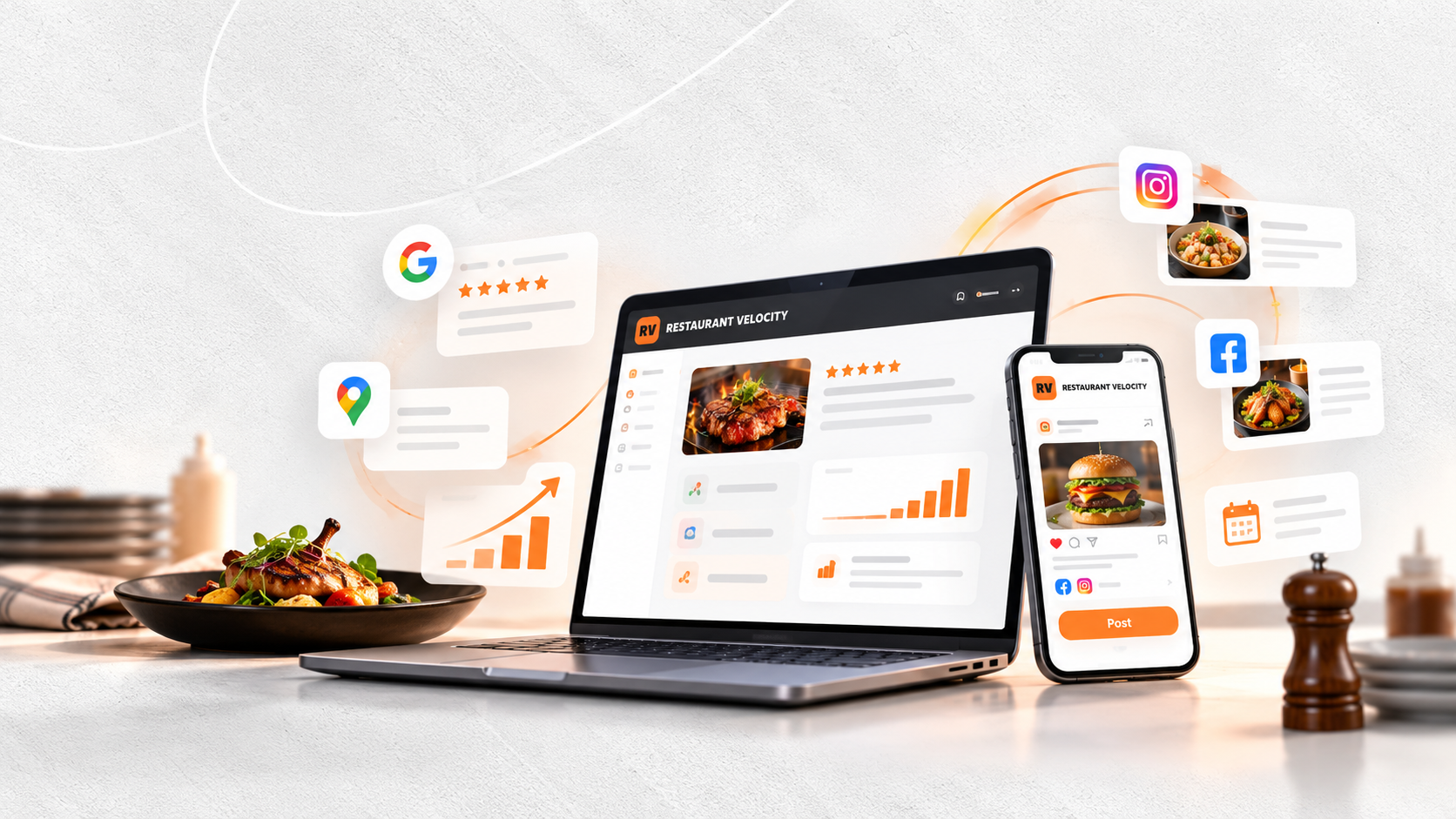
Restaurant Velocity tackles the gap between restaurant reality and its “digital storefront”.
It automates reviews, social replies, Google posts, photos, and profile fixes.
Owners get one visible work queue, with Manual, Assist, or Auto controls.
The platform helps well-run restaurants stop looking inactive or neglected online.
At $50 per location, it aims to save time and missed visits.
Running a successful restaurant requires constant attention. Every service brings new operational decisions, from staffing and inventory to food quality and guest satisfaction. Against that backdrop, replying to yesterday’s Google reviews or uploading fresh photos can easily feel like work that can wait.
But customers do not see the operational pressure behind the scenes. They see a restaurant’s digital storefront.
They see whether recent reviews received thoughtful responses. They compare photos, opening hours, menu information, and Google Maps rankings. They may notice that a competing restaurant appears more active, more responsive, and more trustworthy—even when the actual dining experience is no better.
Restaurant Velocity is built around this gap between operational reality and digital perception. The platform automates recurring local-marketing tasks for independent restaurants, helping them maintain their presence across Google, Facebook, and Instagram without requiring the owner to become a full-time marketing manager.
Its real value is not simply that it can generate content with artificial intelligence. It is that it converts scattered, easily neglected marketing responsibilities into a visible operating workflow where every task can be drafted, reviewed, approved, or automated.
The Problem Is Usually Time, Not Marketing Knowledge
Most restaurant owners understand that reviews should receive responses. They know their Google Business Profile needs accurate hours, current photos, complete service descriptions, and regular posts. They also understand that unanswered social media comments can leave potential customers waiting.
The difficulty is consistency.
An owner may spend an afternoon updating the restaurant’s profile, replying to reviews, and scheduling posts. Then a staff member calls in sick, a supplier misses a delivery, or the restaurant enters a busy weekend. Marketing returns to the bottom of the list.
This creates a familiar cycle: the digital presence receives attention in short bursts, followed by long periods of inactivity.
Restaurant Velocity approaches this as an operational problem rather than a lack of creativity. Instead of giving owners another blank dashboard and expecting them to remember what needs doing, it continually identifies the next relevant tasks and places them in a central work queue.
That distinction matters. Restaurants rarely need another tool that tells them to “engage their audience.” They need the review replies written, the photographs organized, the profile gaps identified, and the next Google post ready for approval.
One Queue for the Restaurant’s Recurring Digital Work
Restaurant Velocity connects to Google, Facebook, and Instagram through their official authorization systems. It then scans the connected profiles for work that needs attention.
The result is a queue containing specific actions rather than abstract analytics. An owner might open the platform and find several review responses ready to approve, unanswered Instagram comments, a Google post prepared for the coming week, new photographs waiting to be categorized, and suggested improvements to the restaurant’s Google profile.
Each item carries a status, making it possible to see what has been drafted, what requires attention, and what has already been published.
This “proof of work” model is one of the platform’s strongest ideas. Traditional agencies often summarize their activity in a monthly report, while separate marketing tools each show only one part of the picture. Restaurant Velocity makes the actual work visible as it moves.
For an owner, that can make the difference between vaguely assuming the marketing is being handled and knowing precisely what has happened.
Review Responses That Attempt to Preserve the Restaurant’s Voice
Automated review responses are not new, but many sound unmistakably generic. A formulaic message thanking every customer for “their valuable feedback” may be technically polite, yet it does little to communicate the personality of an independent restaurant.
Restaurant Velocity says it builds a voice profile using the restaurant’s previous review responses, website language, and social media captions. Its drafts can therefore draw from the tone and vocabulary the business already uses.
The system is also designed to learn from the operator’s decisions. Approving, editing, or rejecting drafts provides additional signals about what sounds appropriate. Restaurants can prohibit particular words or phrases so that they do not appear in future responses.
More sensitive situations receive additional caution. According to the company, critical reviews can be held for human attention instead of being published automatically. This is important because a complaint involving food safety, discrimination, service failure, or a disputed charge requires judgment—not simply a well-written paragraph.
AI can reduce the time needed to prepare a response, but it cannot know every event that occurred inside the restaurant. The most responsible role for automation is therefore to prepare routine work while escalating situations that require context.
Social Comments Become Actionable Conversations
Restaurant marketing does not end with publishing content. A potential customer may ask through Instagram whether walk-ins are accepted on Friday. Another may use a Facebook comment to ask about dietary options, parking, reservations, or operating hours.
When those comments are overlooked, the restaurant may lose more than engagement. It may lose a visit.
Restaurant Velocity gathers Facebook and Instagram comments into a dedicated inbox and prepares responses in the restaurant’s voice. This allows the team to answer practical questions, acknowledge regular customers, and respond to reactions without repeatedly checking different applications.
The platform should not be confused with a complete social media management suite. It is more narrowly focused on the interactions that independent restaurant teams are likely to leave unanswered.
That narrower scope may actually be an advantage for its intended customer. Restaurant operators do not necessarily need dozens of campaign-management features. They need a manageable way to ensure that genuine customer questions do not remain ignored for days.
Giving Google Business Profiles a Consistent Publishing Rhythm
Google Business Profile functions as a digital storefront for many restaurants. Customers encounter it while deciding where to eat, often before visiting the restaurant’s website or social accounts.
An inactive profile can quietly weaken that first impression.
Restaurant Velocity drafts weekly Google posts using information that already exists, including menu updates, restaurant events, social media captions, and seasonal occasions. Instead of asking the owner to create a new marketing idea from nothing, it repurposes the restaurant’s current activity into profile content.
This is a sensible application of generative AI. The platform is not trying to invent an artificial identity for the restaurant. It is attempting to extract useful material from what the restaurant is already doing and convert it into a consistent publishing cadence.
That could mean highlighting a limited menu item, announcing an upcoming event, promoting a seasonal dish, or adapting a successful Instagram caption for Google.
The restaurant remains responsible for verifying claims, prices, dates, availability, and other operational details before publication. A polished but outdated promotion can be more damaging than no post at all.
Turning a Disorganized Photo Library Into a Useful Asset
Restaurant profiles often accumulate a chaotic mix of images. Old exterior photographs appear beside customer uploads, poorly lit dishes, outdated menus, and pictures that no longer represent the current dining room.
Restaurant Velocity organizes photographs into categories such as food, interior, exterior, team, menu, behind-the-scenes content, logos, and cover images. It also evaluates image quality and prepares captions for stronger photographs.
This does not replace professional food photography, and it cannot make an inaccurate photograph acceptable. Its benefit is administrative: it helps the restaurant use the visual material it already possesses more systematically.
For a busy operator, photo organization is exactly the kind of small task that is easy to postpone indefinitely. Automating the sorting and caption preparation makes it more likely that the strongest images will actually reach the customer-facing profile.
A 38-Factor Audit for Detecting Profile Gaps
Some weaknesses in a Google Business Profile are obvious, such as incorrect opening hours. Others are easier to miss: incomplete attributes, weak category choices, missing service descriptions, insufficient photo variety, unanswered reviews, or an inconsistent posting history.
Restaurant Velocity says its audit examines the profile across 38 factors covering areas such as reviews, responses, posts, photographs, hours, categories, and attributes.
It then identifies weaknesses and drafts the copy needed to address some of them. Crucially, proposed Google profile changes always require approval—even when other workflows are placed in an automated mode.
This boundary is appropriate. Changing a public response is one thing; altering a restaurant’s core business information is another. Incorrect hours, service options, or menu descriptions can directly mislead customers.
By requiring approval for profile modifications, the software keeps the operator involved in decisions where factual accuracy matters most.
Local Rankings as a Map, Not a Single Number
Search ranking is not uniform across a city. A restaurant may rank prominently for a query made one kilometre away but appear far lower for someone searching from another neighbourhood.
Restaurant Velocity represents this variation through a local ranking grid, configured as a seven-by-seven map by default. Each point shows how the restaurant appears from a different nearby location. The system can also identify competitors winning areas where the restaurant has weaker visibility and track changes over time.
This is more informative than a single claim that the restaurant “ranks fourth on Google.” Local search results depend heavily on the searcher’s physical position, the query used, competition, relevance, and other factors.
The grid therefore gives operators a more realistic view of their digital territory. A restaurant may discover that it performs well close to its address but loses visibility a few blocks away, or that a particular competitor dominates searches in one direction.
Restaurant Velocity can connect those observations with potential profile improvements, although operators should avoid treating every ranking movement as proof that one specific change caused it. Google’s local results are influenced by many variables, and correlation is not the same as causation.
Manual, Assist, or Auto: Automation With Adjustable Boundaries
Restaurant owners differ considerably in their tolerance for automation. Some want to approve every word, while others are comfortable allowing routine responses to publish automatically.
Restaurant Velocity addresses this with three control modes:
- Manual mode prepares drafts but publishes nothing without approval.
- Assist mode can publish work that satisfies the operator’s chosen confidence rules while holding uncertain or sensitive items.
- Auto mode publishes eligible work according to an established cadence, while still allowing the operator to intervene.
These settings can be applied separately to review replies, social comments, and posts. A restaurant might automate positive-review responses while requiring approval for every social reply and Google post.
All new accounts begin in Manual mode. This gives the operator time to examine the system’s writing, correct its assumptions, and refine the voice profile before permitting greater autonomy.
That gradual progression is preferable to treating automation as a binary choice. Trust should be earned through observed performance, especially when software is communicating publicly in the name of a business.
The company also states that Google profile changes always remain subject to approval. Even an account using Auto mode cannot silently apply those modifications.
Where Restaurant Velocity Fits—and Where It Does Not
Restaurant Velocity is designed primarily for independent restaurants and smaller multi-location groups whose digital presence is important but under-managed.
It is not a replacement for a point-of-sale system, reservation platform, customer relationship management suite, ordering service, or comprehensive enterprise listings network. It also does not replace a marketing agency responsible for brand strategy, website development, advertising, technical SEO, or large creative campaigns.
Instead, it occupies the operational layer between strategy and execution.
An agency might recommend publishing weekly profile updates, responding consistently to reviews, and refreshing photographs. Restaurant Velocity focuses on getting that recurring work prepared and completed.
The platform also cannot solve deeper restaurant problems. It cannot compensate for poor food, inaccurate menus, weak hospitality, unreliable service, or consistently negative customer experiences. Faster review responses may improve communication, but they do not eliminate the reasons customers are complaining.
Its best customer is therefore not a failing restaurant hoping AI will repair its reputation. It is a reasonably well-run restaurant whose online presence does not consistently reflect the quality of the actual business.
Pricing Keeps the Proposition Simple
Restaurant Velocity currently advertises a founding price of $50 per location per month, with all workflows included. Its pricing page lists no setup fees, feature tiers, add-ons, or per-seat charges.
The subscription includes review and social-comment drafts, Google posts, photo organization, profile auditing, local ranking grids, competitor tracking, and the three control modes.
The company offers a 14-day trial without requiring a payment card, with billing beginning on day 15 only if the restaurant continues. Locations added during a billing period are prorated, and work already published to the restaurant’s profiles remains there after cancellation.
However, the company describes $50 as limited founding-customer pricing. Its FAQ indicates that the standard rate is expected to become $99 per location after the initial allocation is filled. Restaurants should therefore confirm the current price and eligibility directly before subscribing.
At the advertised founding rate, the proposition is easy to understand: the software needs to save only a modest amount of owner or manager time—or help prevent a small number of lost customer visits—to justify its monthly cost.
The real test is whether the drafts require minimal correction and whether the platform identifies useful work rather than simply increasing the number of tasks an operator must review.
Data Access Requires Serious Safeguards
Connecting software to a restaurant’s public profiles requires trust. Restaurant Velocity says it uses official OAuth connections, allowing operators to disconnect access instead of sharing account passwords.
Its security overview states that data is encrypted in transit and at rest, while customer accounts are separated at the database level. The company also says internal production-data access requires an authorized support reason and is logged.
These are encouraging design choices, but the company is still developing its formal compliance position. Its security page describes SOC 2 Type 1 as being in progress rather than already completed.
Restaurants—particularly larger groups with strict vendor requirements—should review the privacy policy, subprocessors, data-retention terms, incident procedures, and current certification status before granting access.
The Bigger Idea: Restaurant Marketing as an Operating System
The most interesting part of Restaurant Velocity is not any single AI feature. Review generation, post writing, photo classification, and profile auditing can all be found in different forms elsewhere.
Its stronger idea is to treat restaurant visibility as a collection of recurring operational jobs.
Each job has an input, a draft, a status, an approval rule, and a publishing outcome. The restaurant can decide which work needs human judgment and which can move automatically. Instead of marketing being an occasional project, it becomes a controlled weekly rhythm.
That approach fits the realities of independent restaurants. Owners generally do not ignore digital marketing because they believe it is unimportant. They ignore it because something more urgent is always happening inside the restaurant.
Restaurant Velocity is designed for the space between important and urgent. It handles the repeatable preparation, keeps the unfinished work visible, and asks the operator to make only the decisions that still require human context.
A More Active Digital Storefront Without Another Full-Time Job
Customers frequently judge a restaurant before they taste its food. They compare ratings, read responses, examine photographs, check recent activity, and decide whether the business appears reliable.
Maintaining that digital storefront requires dozens of small actions, none of which seems overwhelming in isolation. Together, however, they become a permanent workload.
Restaurant Velocity tries to reduce that burden by combining discovery, drafting, approval, publishing, and monitoring in one restaurant-specific workflow. Its Manual, Assist, and Auto modes give businesses a practical path from cautious experimentation to selective automation.





It will not replace hospitality, improve a dish, or rescue a weak operation. What it can potentially do is ensure that a good restaurant no longer looks neglected online simply because its team is busy running the actual restaurant.
For independent operators, that may be the most valuable form of marketing automation: not producing more noise, but consistently completing the digital work that customers already use to decide where to eat.