 LEAP26
 AI
AI Saudi Arabia
 UAE
UAE Egypt
EgyptI am Mohamed Adel. I turned HR into disciplined systems

8 min
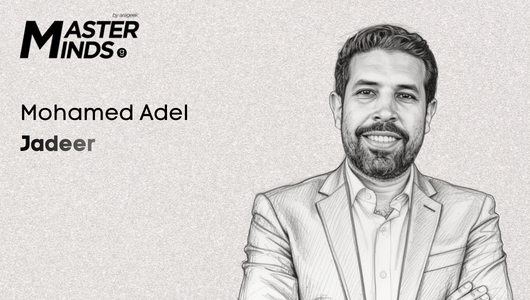
Mohamed Adel does not speak about HR as a support function. He speaks about it as infrastructure.
Across oil and gas, logistics, retail, BPO and now AI-enabled consulting, his throughline has been consistent: systems first, judgement always, and impact measured in outcomes, not intentions. As Managing Director of Jadeer, he is now applying that thinking to a new frontier, practical AI adoption inside business teams.
Below is a conversation shaped by those priorities.
How he moved from recruitment coordinator to systems builder
When asked to introduce himself, Mohamed Adel does not romanticise the journey. He starts with discipline.
His career began on the agency side as a Recruitment Coordinator. It was transactional work, but it taught him speed, quality control and client communication under pressure. “That foundation never leaves you,” he suggests, because agency work forces clarity and accountability early.
The shift to corporate HR with Maersk Drilling expanded the canvas. Supporting around 1,200 employees across nationalities and locations exposed him to scale, complexity and fairness in real operational environments. HR there was not theoretical. It was tied to performance, compliance and multi-cultural dynamics.
At Kuehne + Nagel, the scope broadened further. Global standards, cross-functional leadership and structured processes shaped his thinking. Later, moving back into the agency world as Consulting Director at a UK-based HR consulting firm added another layer: advisory work across industries and remote team leadership. Corporate depth met consulting breadth.
Today, at Jadeer, the focus has shifted again. The mandate is no longer only hiring or policy. It is helping business teams adopt AI in ways that materially improve output quality and save time.
Why HR became a long-term commitment
On the question of why HR, and why stay, his answer is pragmatic.
HR sits at the intersection of people and business results. It is one of the few functions where performance improvement and dignity protection coexist. That dual responsibility is what kept him in the field.
What sustained it long term, however, is change. Workforce expectations evolve. Operating models shift. Technology resets the baseline. For someone who enjoys building systems that enable performance, HR offers a constantly moving problem set.
He is motivated less by titles and more by impact. When HR is done properly, he argues, it influences careers, families and organisational health over decades.
How different industries sharpened his judgement
When the conversation turns to sector differences, he pushes back on the idea that industry defines HR success.
The differentiator is mindset. Learn the business quickly. Understand its operating rhythm. Design HR solutions that match reality.
Each sector added a lens. Oil and gas reinforced rigour and compliance. Logistics emphasised scale and process discipline. Retail brought speed and frontline realities. BPO demanded volume hiring under pressure while protecting employee experience.
The constant thread was alignment. HR works when it speaks the language of the business and builds solutions grounded in operational context.
What diverse teams taught him about responsibility
Asked to reflect on working with multiple nationalities and complex personal contexts, he highlights responsibility more than diversity.
HR sees the full human story behind performance. Family pressures, mobility issues, cultural nuances, financial realities. That visibility creates obligation.
His rule is simple: empathy, confidentiality and fairness. The timing of an intervention matters. A well-handled HR decision can alter someone’s trajectory far beyond their job description.
Why international hiring fails after the offer letter
Pressed on international hiring challenges, he reframes the problem.
The difficulty is not sourcing talent. It is retention. Companies underestimate onboarding quality, leadership capability, cultural integration and career clarity.
Hiring is the start of a relationship, not a transaction. Clear expectations, competitive total value, strong managers and visible growth pathways determine whether a hire becomes a long-term asset.
Retention, in his view, is the real measure of whether the hiring decision was correct.
Balancing clients and candidates without compromising either
When asked how he balances client expectations with candidate experience, he reduces it to two principles: transparency and respect.
Candidates receive honest communication about role scope, timelines and challenges. Clients receive realistic assessments of strengths and development gaps.
He also emphasises courage. If a candidate is strong but misaligned for a specific role, Jadeer may recommend an alternative position rather than force a fit. Trust, he argues, compounds over time. Short-term placements that ignore alignment damage both sides.
What “modern HR operations” actually means
On the question of modern HR, he is precise.
Modern HR operations move from opinion to evidence. Data, analytics and measurable outcomes reduce subjectivity. Decisions are anchored in facts rather than instinct alone.
Importantly, this does not remove the human dimension. It strengthens it. When the data is clear, HR professionals can spend more time on judgement and relationships instead of debating assumptions.
Why Jadeer is betting heavily on practical AI
When asked about Jadeer’s focus, two priorities emerge.
First, enabling non-technical business teams to use AI in daily workflows. In 2025 alone, Jadeer delivered AI programmes to more than 2,000 employees across its B2B client base. The emphasis is not conceptual understanding but task-level application that saves time and improves output quality.
Second, building AI tools for recruiters. Accelerating CV screening, supporting shortlisting, reducing manual workload and protecting hiring quality under tight deadlines.
The programmes span managers, HR, finance, marketing, customer service and general business productivity. University-focused tracks are also in development, centred on building new skills through AI. Everything is tailored to actual pain points rather than generic curricula.
How being part of Future Group strengthens delivery
When the conversation shifts to structure, he credits Future Group’s operational backbone.
Shared infrastructure, exposure to multiple markets and large-scale operations, and operational discipline allow Jadeer’s solutions to function in real business conditions. Not theoretical frameworks, but tested systems that withstand scale and complexity.
The operational improvements he values most
Asked what he is proudest of, he does not mention growth figures.
He points to discipline and consistency. Transforming HR delivery from individual heroics into repeatable systems. Clear workflows, defined service levels, measurable reporting and a culture that balances speed with quality.
The result was predictable delivery, clearer accountability and smoother experiences for both clients and candidates. The same structured approach enabled training programmes to scale while remaining practical and task-oriented.
How Jadeer differentiates itself in a crowded market
When pressed on differentiation, he outlines three pillars.
Business-first HR. Hiring and advisory aligned to outcomes, not activity.
Process discipline. Strong workflows, clear service standards and measurable performance.
Practical AI enablement. Real workflow redesign, not conceptual workshops. In certain cases, task time was reduced by up to 90 per cent because the method changed, not because people were pushed harder.
How AI is actually changing HR work
On AI’s impact, he avoids hype.
In talent acquisition, AI improves CV triage, job advertisements, sourcing messages, structured interview guides and reporting clarity.
In HR operations, it supports policy drafting, communications, training content and feedback summaries.
The outcome is straightforward: less administrative burden, more time for high-value judgement and relationships.
Adoption improves when AI is tied directly to real tasks within each function and introduced with clear guardrails.
Where HR teams should start with AI
Asked for immediate starting points, he recommends low-risk, high-impact applications:
Job description improvement and competency-based profiles.
Personalised sourcing messages.
Structured interview guides and screening question banks.
Candidate summary templates for consistent shortlists.
Meeting and interview note summarisation.
Hiring funnel and time-to-fill reporting drafts.
Internal communication drafts for policies and announcements.
These deliver visible efficiency gains quickly and build confidence.
Will AI replace HR professionals?
On the question of replacement versus augmentation, he is firm.
AI will augment HR. The function is built on judgement, ethics and trust. What will change is the skill set. Professionals anchored only in manual administrative work will feel pressure. Those who learn to use AI responsibly will become faster and more strategic.
The future HR professional, he argues, is not less human. It is more human, equipped with stronger tools.
His advice to future HR leaders
Asked to advise young HR professionals, his guidance returns to fundamentals.
Learn how the business makes money. Without that understanding, influence is limited.
Build credibility through execution. Reliability and clear communication matter.
Master the basics: interviewing, employee relations, stakeholder management and data literacy.
Finally, be intentional about leadership. Seek feedback. Develop coaching capability. Form a point of view. In global environments, cross-cultural fluency becomes a decisive advantage.
For Mohamed Adel, HR has never been about soft skills alone. It is about structured judgement applied consistently, now accelerated by intelligent tools.